In the Wave of Digitalization: How Hot Melt Drilling-Tapping-Milling Integrated Machines Break Through the Bottlenecks of Liquid Cooling Pipe Processing for Data Centers
Amid the wave of digitalization, the “Eastern Data and Western Computing” strategy has become a crucial engine driving the development of China’s computing power industry. With the explosive growth of data volume, data centers, as the core bearing platforms for computing power, are facing increasingly prominent energy consumption issues. Relevant data shows that the power consumption of data centers in China has been rising year by year, reaching 216.6 billion kWh in 2021, accounting for approximately 2.6% of the country’s total power consumption, with carbon emissions amounting to 135 million tons, accounting for about 1.14% of the national carbon dioxide emissions. Against the backdrop of the “dual carbon” goals (carbon peaking and carbon neutrality), the green transformation of data centers is extremely urgent.
Liquid cooling systems, with their efficient cooling capabilities, have gradually become the mainstream choice for data centers to reduce energy consumption. Take immersion liquid cooling as an example: it can fully immerse servers in insulating cooling liquid, and through liquid boiling or circulating heat dissipation, its heat dissipation efficiency is 50 times higher than that of traditional air cooling. It can support a high power density of over 100kW per cabinet, while reducing noise by 90%. The PUE (Power Usage Effectiveness) value of data centers can reach around 1.05, significantly improving energy utilization efficiency.
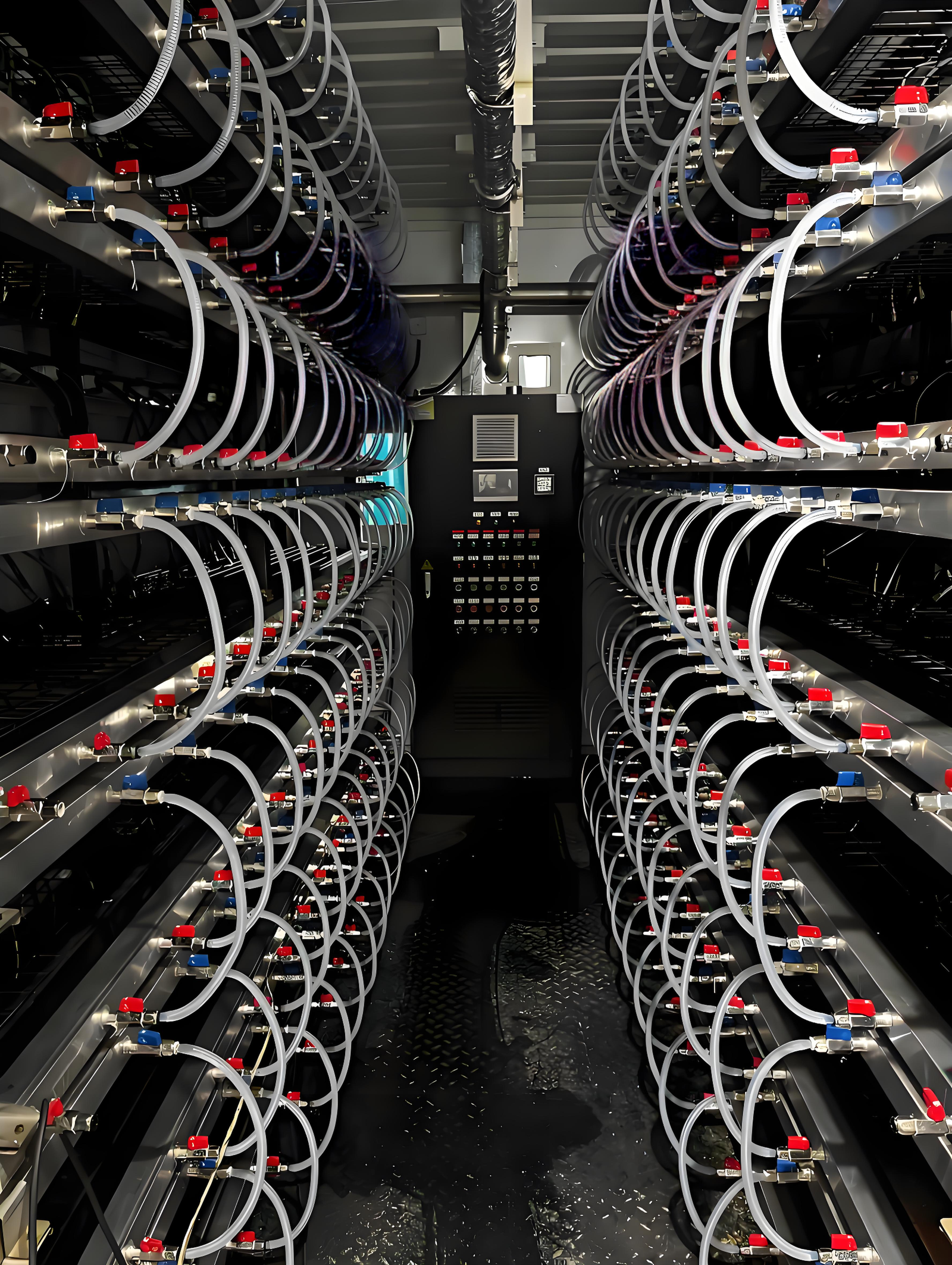
In liquid cooling systems, stainless steel liquid cooling pipes, as the key channels for cooling liquid transmission, play a vital role. The wall thickness of these stainless steel pipes usually ranges from 0.5 to 6mm, and they need to withstand a certain level of pressure and temperature changes to ensure the stable transmission of cooling liquid. However, traditional stainless steel pipe processing technologies face numerous difficulties when dealing with these thin-walled pipes.
In the tapping process, due to the good plastic toughness and high work hardening tendency of stainless steel materials, traditional tapping methods are prone to thread slipping. Statistics show that when using ordinary taps for tapping, the probability of thread slipping is as high as 30%, which not only increases the processing scrap rate but also raises production costs and time costs. During drilling, the low thermal conductivity of stainless steel leads to excessively high temperatures in the drilling area and a high pipe deformation rate, seriously affecting the precision of the pipes and their subsequent use. Moreover, traditional processing often requires multiple processes, from drilling to tapping and then milling. Frequent process switching results in extremely low production efficiency, which cannot meet the needs of large-scale data center construction. These processing difficulties, like “tightening curses”, restrict the rapid development of liquid cooling systems in data centers and have become a key “bottleneck” link limiting the progress of data center construction. However, the birth of hot melt drilling-tapping-milling integrated machines is like a ray of light, bringing hope for solving this dilemma.
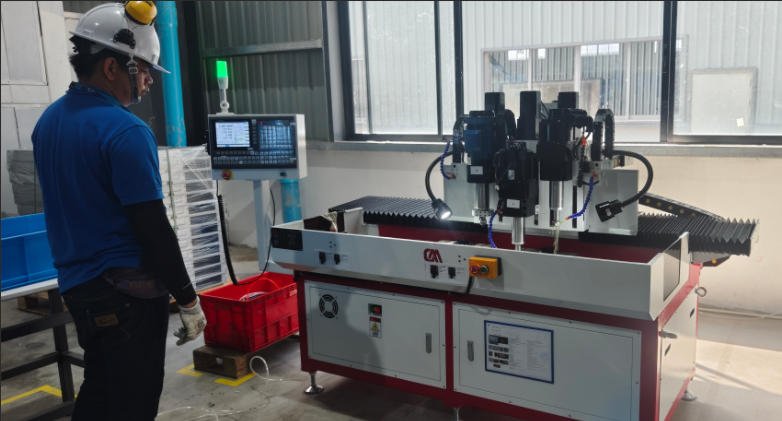
Hot Melt Drilling-Tapping-Milling Integrated Machines
II. Three Major Pain Points of Traditional Processing: How the Integrated Machine Overcomes Them One by One
(I) Thin-Wall Vulnerability: No More Troubles with Thread Slipping and Deformation
In the processing of dedicated liquid cooling stainless steel pipes for data center computer rooms, stainless steel pipes with a wall thickness of 0.5-6mm can be called “fragile products”. The traditional rigid tapping method is like a reckless strongman. During the processing, due to excessive axial pressure, the pipe wall is easily torn like fragile paper. In this case, the qualification rate of threads can only reach 60%-70%, which means that for every 10 pipes processed, 3-4 may have thread quality problems and need to be reworked or even directly scrapped.
The hot melt drilling-tapping-milling integrated machine has brought revolutionary changes. The hot melt drilling technology it adopts is like a gentle and skillful craftsman. Through high-speed rotation of 5,000-24,000 rpm, intense friction is generated between the drill bit and the stainless steel pipe, instantly raising the temperature to the metal softening point, which is 800-1000°C. At this temperature, the metal becomes soft and malleable as if enchanted. At this point, by squeezing the softened area, a non-cutting bushing can be easily formed. During the subsequent tapping process, with the support of this solid bushing, the thread strength is increased by 30%, and the thread slipping rate is reduced to below 5%, fundamentally solving the problem of rigid damage during thin-walled processing.
(II) Fragmented Multi-Processes: One-Step Formation of Drilling – Tapping – Milling
Traditional stainless steel pipe processing is like a tedious relay race, requiring frequent tool changes and fragmented processes. From drilling to tapping and then to milling, each step requires careful tool switching and equipment parameter adjustment. Taking the processing of a single pipe as an example, this process often takes 15-20 minutes, with extremely low efficiency. Moreover, frequent manual operations are like frequent baton handovers in a relay race; a slight carelessness can easily lead to errors, affecting processing precision.
The hot melt drilling-tapping-milling integrated machine, however, is like an all-around champion. Equipped with a dual-axis and dual-spindle structure, it realizes seamless connection between the drilling and tapping processes. Combined with an automatic tool change system, the tool change time is less than 5 seconds, as fast as lightning. It can complete five processes in one go: “hot melt drilling (2-6 seconds per hole) → precision detection → tapping → chamfering → milling”, with the entire process being automated. This increases the processing efficiency of a single pipe by 40% while avoiding precision deviations caused by manual intervention. The once lengthy processing process has now become efficient and accurate, greatly improving production efficiency.
(III) Precision Out of Control: Accurate Control of Millimeter-Level Errors
The pipeline installation of data centers has extremely strict requirements for precision, with errors that must be controlled within ±0.02mm. The traditional manual detection method is like measuring the thickness of a hair with the naked eye, which is highly susceptible to human factors. For example, the operator’s experience level, mental state on the day, and even slight tremors during measurement may cause deviations in the measurement results, ultimately affecting the installation precision of the pipeline and the sealing performance of the liquid cooling system.
The integrated machine has brought a “secret weapon” for precision control – an integrated high-precision detector. After processing is completed, it acts like a rigorous quality inspector, automatically collecting data such as hole height and concentricity, and feeding it back to the numerical control system in real time, such as Taiwan’s Syntec or Japan’s Fanuc systems. The numerical control system is like an intelligent commander; based on the feedback data, it performs compensation and correction through three-axis linkage, ensuring that the hole spacing error is ≤0.015mm, which fully meets the strict requirements for high-pressure sealed connection of liquid cooling systems. In this way, whether it is the construction of large-scale data centers or high-end projects with extremely high precision requirements, the integrated machine can easily handle them, providing a solid guarantee for the stable operation of liquid cooling systems.

huangjiafeng
请到「后台-用户-个人资料」中填写个人说明。