I. What is Scraping? The “Manual Calibration Technique” for Mechanical Precision
(1) A 200-Year-Old “Micro-Engraving Art” in Metal Processing
In the precision-driven world of modern CNC drilling machines, scraping—an ancient craftsmanship—stands like a mysterious artisan from the depths of time, quietly wielding its magic. Also known as scraping and lapping, this technique originated during the Industrial Revolution. Having endured 200 years of evolution, it remains an irreplaceable manual finishing method in precision machinery manufacturing. It is analogous to performing delicate “micro-engraving surgery” on mechanical components, except that the “canvas” here is not artwork, but the critical contact surfaces that determine a machine’s performance.
Imagine the guide rails and slide plates of a CNC drilling machine: their surfaces may seem flat before assembly, but they actually hide micron-level undulations. Enter the scraping technician, who wields a scraper to remove high spots on these surfaces, adhering to an error tolerance of 0.01–0.001 mm. To put this in perspective: a single human hair has a diameter of approximately 0.1 mm. Technicians meticulously carve 10–100 precision marks within this tiny scale, refining the component’s mating surfaces to an exceptional degree of accuracy—laying a solid foundation for the drilling machine’s stable operation.
(2) Core Principle: The Qualitative Shift from “Surface Contact” to “Point Support”
The core secret of scraping lies in its ingenious transformation of the rough surface contact between mechanical components into a sophisticated point-support structure. In this process, colorants (red lead oxide or blue lead oxide) act as the technician’s “magic markers.” First, the technician evenly applies the colorant to a standard fixture, then slides the fixture against the surface of the workpiece to be scraped. High spots on the workpiece will pick up the colorant, revealing themselves clearly.
Like seasoned hunters, technicians use these marks to precisely scrape the workpiece, leaving regularly distributed concave points on its surface. Ideally, 25 such support points should be evenly distributed per square inch. Though tiny, these points bear a crucial responsibility: they uniformly distribute the pressure generated during component movement, preventing uneven wear caused by localized overpressure. Meanwhile, the small gaps between the points act like miniature oil reservoirs, storing lubricating oil as components slide. This forms a lubricating film that significantly reduces friction—essentially laying a “cushioned, precision track” for mechanical parts, enabling smoother, more stable operation and effectively extending the CNC drilling machine’s service life.
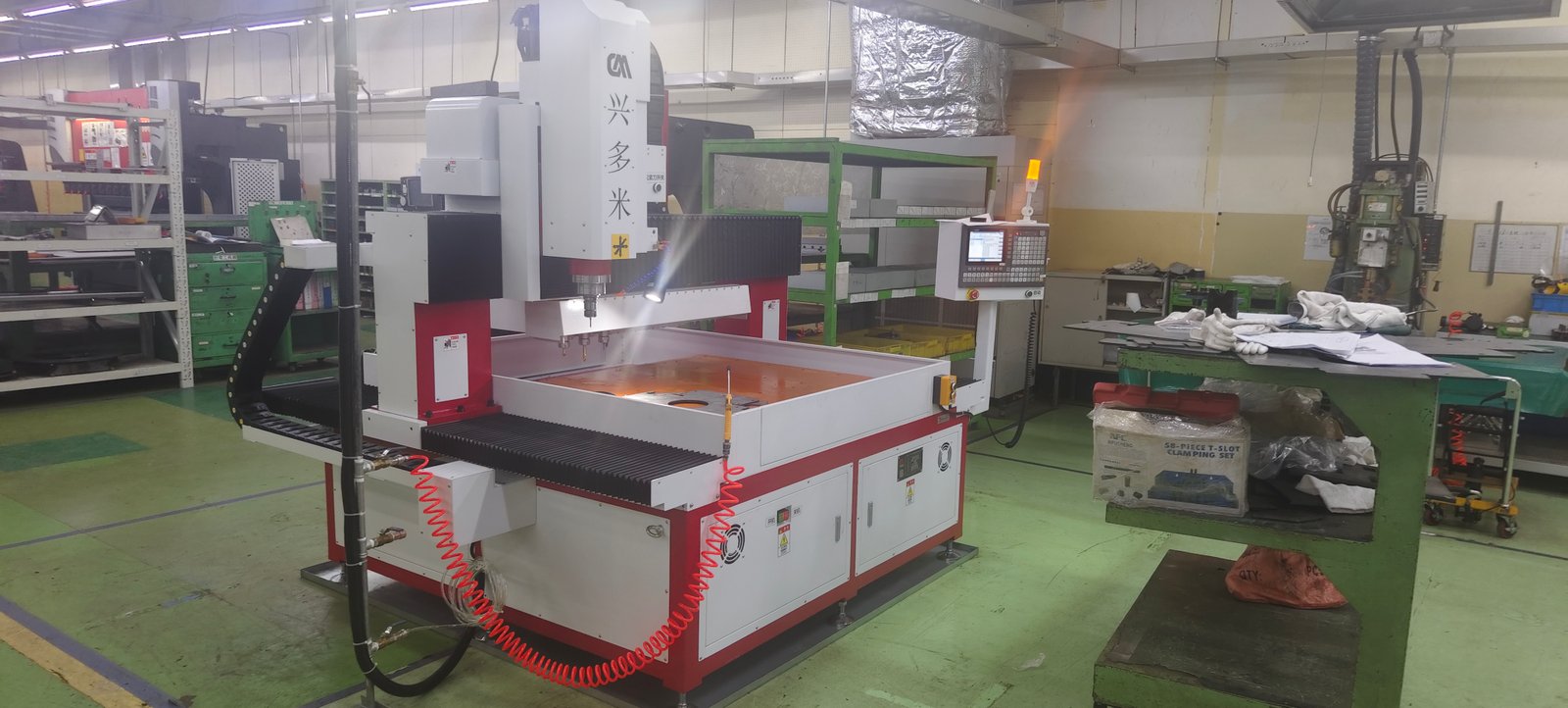
II. Skipping Scraping? These 3 Hidden Risks Will Ruin Your Equipment
At this point, you might wonder: “Scraping seems so tedious—can’t we skip it? Modern machine tools are already so precise; the impact can’t be that big, right?” This is a grave misunderstanding! Skipping scraping is equivalent to planting three “time bombs” in your CNC drilling machine, which could detonate equipment failures and production crises at any moment.
(1) Precision Collapse: “A Millimeter’s Error Leads to a Kilometer’s Deviation”
In precision machining, there is a saying: “A millimeter’s error leads to a kilometer’s deviation”—and this couldn’t be truer for unscraped CNC drilling machines. Machining inherently involves systematic errors (e.g., machine thermal deformation, assembly stress), which lurk like hidden enemies, constantly undermining precision. Unscraped contact surfaces are like rough, potholed roads: their seemingly minor undulations hide major risks, with invisible height differences of over 0.05 mm.
When the drilling machine operates at high speed, these errors are amplified 10–20 times—like light focused by a magnifying glass. A negligible 0.05 mm error suddenly becomes a massive 0.5–1 mm deviation, causing over-tolerance in hole diameter and misalignment of hole positions. In electronic component hole machining, a hole diameter error exceeding 0.01 mm can render components un-weldable, turning entire circuit boards into scrap. In mold hole machining, even a 0.05 mm position deviation creates gaps during mold clamping, leading to severely reduced product dimensional accuracy, flash, burrs, and eventual scrapping. For enterprises, this means direct losses from wasted raw materials and extended working hours—plus incalculable indirect losses from lost customer trust due to poor product quality.
(2) Accelerated Wear: The Fatal Flaw of “Running with Defects”
During operation, CNC drilling machine components rub against each other and bear stress. Without scraping, their contact surfaces are like running in shoes with uneven soles: pressure concentrates on localized areas, causing severe uneven wear. Over 90% of the pressure on an unscraped rough surface focuses on just a few contact points—like “frail shoulders” burdened with a thousand pounds.
Measured data clearly demonstrates scraping’s importance: under identical working conditions, unscraped guide rails have a service life only 1/3 that of scraped ones. As wear worsens, obvious scratches and grooves form on the rails, causing the slide plate to jam and vibrate during movement, failing to follow its intended path smoothly. In extreme cases, bearings may seize due to excessive localized pressure, losing rotational capacity and triggering catastrophic failures like spindle breakage. When this happens, maintenance costs surge 3–5 times—covering not just replacement parts, but also the time and labor of professional technicians for debugging and calibration. The economic losses from production downtime are incalculable.
(3) Vibration and Noise: Visible Signs of Mechanical “Subhealth”
Uneven contact surfaces in a CNC drilling machine are like a car driving on a bumpy mountain road—they trigger high-frequency vibrations (typically 50–200 Hz). These vibrations produce harsh noise (exceeding 85 decibels), which damages operators’ hearing with prolonged exposure. Worse, vibrations transmit through the machine body to the drilling system.
Vibration causes the drill bit to wobble during drilling, disrupting stable cutting and increasing hole wall roughness: the Ra value spikes from a normal 1.6 μm to 6.3 μm. Rough hole walls not only harm product appearance, but also reduce fatigue strength and corrosion resistance, shortening service life. More critically, vibration and noise create a vicious cycle: vibration degrades precision and amplifies noise; noise, in turn, distorts operators’ judgment of the machine’s status, causing them to miss early warning signs of failure. This allows problems to escalate until the machine stops working—severely impacting productivity and product quality.
III. The Core Value of Scraping: A “Cold Working Miracle” Machines Cannot Achieve
By now, you understand scraping’s critical role in CNC drilling machines. But what unique advantages make this ancient technique irreplaceable in modern precision manufacturing? Let’s explore its core value and how it creates “cold working miracles” in modern industry.
(1) “Counterintuitive” Precision Beyond Machine Capabilities
Many assume modern precision machine tools have reached the limit of micron-level accuracy—but scraping, an ancient manual technique, defies this conventional wisdom, achieving “counterintuitive” precision that surpasses machines.
Even the most advanced precision machine tools have a manufacturing tolerance of approximately ±0.01 mm. This is because tool wear, thermal deformation, and assembly errors are unavoidable in machining; these errors accumulate, ultimately compromising workpiece precision.
Scraping is entirely different. Leveraging years of experience and masterful skill, technicians can manually refine the straightness of CNC drilling machine guide rails to within ±0.001 mm. To visualize this: over a 1-meter guide rail, the error is less than 1/10 the diameter of a human hair! This precision approaches the nanoscale—a level modern machine tools cannot reach under normal processing conditions.
How does scraping achieve this? The key lies in its no thermal deformation, no clamping stress characteristics. Machining generates cutting forces and heat, causing micro-deformations in workpieces (invisible during processing but harmful to final precision). When technicians use scrapers for manual scraping, they apply minimal force, generating almost no heat—eliminating thermal deformation. Additionally, scraping requires no heavy clamping of the workpiece, eliminating deformation risks from clamping stress. In this way, scraping precisely corrects errors from machining, achieving true high-precision finishing.
(2) The “Perfect Partner” for Lubricating Oil
For CNC drilling machines, a robust lubrication system is critical to normal operation and extended service life. Scraping acts as the “perfect partner” for lubricating oil, providing strong support for efficient drilling machine performance.
Scraped workpiece surfaces feature a grid of regularly distributed concave points (typically 0.02–0.05 mm deep). These tiny indentations function as carefully designed “miniature oil reservoirs,” playing a vital role in CNC drilling machine operation.
As the machine’s guide rails and slide plates slide against each other, lubricating oil is evenly stored in these concave points. Research shows that the scraped concave point grid increases the uniform distribution rate of lubricating oil on the workpiece surface by over 70%. At high sliding speeds (e.g., 20 m/min feed rate), the oil stored in these points quickly forms a stable oil film (approximately 0.01 mm thick). This film acts as an invisible protective layer, separating metal surfaces and reducing the friction coefficient by over 30%—achieving an ideal “near-zero dry friction” operating state.
In contrast, unscraped surfaces struggle to form a uniform, stable oil film—even with lubrication. At high speeds, oil is easily squeezed out, causing localized dry friction and accelerated component wear. Thus, the unique surface structure created by scraping provides optimal conditions for oil storage and distribution, enhancing lubrication, reducing wear, and extending the CNC drilling machine’s service life.
(3) The “Preservative” for Mechanical Service Life
The service life of a CNC drilling machine directly impacts an enterprise’s productivity and cost. Scraping acts like a powerful “preservative” for mechanical life, significantly extending equipment longevity and creating greater value for businesses.
Numerous practical cases and experimental data confirm that key components of scraped CNC drilling machines typically have their service life extended by 5–10 years. For example, an automotive parts manufacturer conducted a comparative test: scraped drilling machines operated continuously for 8 years, with guide rail wear of only 0.03 mm—still maintaining excellent machining precision and operational stability. In contrast, unscraped machines developed severe guide rail wear and precision degradation after just 3 years, requiring costly overhauls and causing production downtime.
Scraping extends mechanical life by solving two critical issues in machine operation: precision retention and wear control. Scraping achieves ultra-high precision and flatness on component contact surfaces, ensuring uniform force distribution during operation and preventing premature wear from localized stress. Additionally, the superior lubrication conditions created by scraping minimize friction between components, further reducing wear. Over long-term use, this effective control of precision and wear keeps the drilling machine in optimal condition, extending its overall service life and saving enterprises significant costs on equipment replacement and maintenance.
IV. When Machines Depend on Hands: Unveiling the Scraping Technician’s “Human Radar”
(1) Refined “Muscle Memory” Through Thousands of Hours of Practice
In CNC drilling machine manufacturing workshops, scraping technicians are like master artists, showcasing breathtaking skill on metal surfaces. Becoming a qualified scraping technician is no easy feat—it requires at least 3 years of arduous training, filled with challenges and rigor.
During their long apprenticeship, technicians repeat the seemingly monotonous yet profoundly intricate cycle of “coloring → lapping → scraping” tens of thousands of times. Each application of colorant lays the groundwork for precision “painting”; each lapping step pursues extreme surface smoothness; each scrape is a precise carving in the micron-scale world.
After countless repetitions, technicians develop an extraordinary “body scale.” When scraping, they use waist strength to control the scraping length with an astonishing error tolerance of ≤0.05 mm—comparable to an elite sprinter precisely controlling their stride and rhythm in every start and sprint.
Meanwhile, their left hand hones an exceptional tactile sensitivity, detecting subtle pressure changes to adjust scraping depth with 0.001 mm precision—similar to a blind masseuse who uses touch to sense tiny changes in human muscles and bones for accurate therapy.
Their eyes function like high-precision microscopes, detecting 0.002 mm height differences by observing the distribution of colored marks. Fixated on the workpiece surface, technicians miss no detail—like a focused detective searching for clues at a crime scene. This highly coordinated integration of senses allows technicians to achieve machine-defying precision and stability in manual operations, making them indispensable to CNC drilling machine manufacturing.
(2) The Vanishing “Industrial Intangible Cultural Heritage”
Amid today’s wave of automation, many traditional manual techniques face severe challenges—and scraping is no exception. Data shows that only a few thousand technicians nationwide master advanced scraping skills—a tiny number compared to the massive demands of the manufacturing industry.
A factory director with years of experience in CNC equipment once lamented: “The cost of training a skilled scraper is equivalent to buying a mid-range drilling machine.” Training involves learning basic theory, repeated hands-on practice, and accumulating experience—requiring enormous time, effort, and financial investment.
Yet the value of these technicians far exceeds their training costs. They are like the “soul shapers” of CNC drilling machines, imbuing equipment with unparalleled precision and stability. In high-end manufacturing, this “human-machine symbiosis” and craftsmanship spirit are core components of an enterprise’s competitive edge.
Take Japan as an example: its “Living National Treasure” technicians, renowned for their masterful scraping skills, have become the gold standard of the precision machine tool industry. Their scraping expertise not only represents Japan’s highest level of manufacturing, but also serves as a core selling point for Japanese precision machine tools in the global market. With their hands, these technicians embody the spirit of craftsmanship, earning global acclaim for Japan’s high-end manufacturing.
In China, while the number of scraping technicians is declining, their value is becoming increasingly prominent. Many enterprises spare no expense to hire them, seeking to elevate the precision and performance of their CNC drilling machines. These technicians not only inherit ancient scraping techniques but also innovate and adapt, combining traditional craftsmanship with modern technology to inject new vitality into the development of CNC drilling machines.
V. “Cosmetology” for Equipment: When is Scraping Needed?
(1) “Unlocking Precision Seals” During New Machine Assembly
For CNC drilling machines, new machine assembly is like a carefully orchestrated precision symphony—and scraping is its climactic highlight. Before a CNC machine tool leaves the factory, over 90% of its precision components (e.g., V-shaped guide rails, lead screw bearing blocks) undergo scraping—a “sacred ritual” to “unlock precision seals.”
This is especially true for high-end models pursuing extreme precision (positioning accuracy ≤±0.005 mm), where scraping becomes the core process determining equipment quality. In assembling these high-precision CNC drilling machines, scraping typically accounts for 40% of total assembly time—analogous to a top chef spending hours preparing and seasoning ingredients to create a perfect dish.
In practice, consider a well-known brand’s high-precision CNC drilling machine: during assembly, scraping technicians meticulously scrape every critical component. With their scrapers, they carve the guide rail surface, each mark a testament to their pursuit of precision. After scraping, the guide rail’s straightness reaches an astonishing ±0.001 mm, and flatness is controlled within a minimal ±0.002 mm tolerance. This high-precision scraping ensures the drilling machine operates smoothly and accurately, easily handling complex machining tasks and delivering an exceptional user experience.
(2) “Rejuvenation Therapy” for Old Machine Overhauls
After long-term high-intensity operation, a CNC drilling machine—like a seasoned warrior—inevitably suffers wear and aging. At this point, scraping acts as a magical “rejuvenation therapy,” restoring the old equipment to its prime.
When equipment exhibits reduced machining precision (e.g., hole position deviation exceeding ±0.02 mm), abnormal noise during operation, or lubrication system failure, scraping is often the most cost-effective repair solution. Replacing entire guide rails, by contrast, is not only expensive but also risks mismatching new rails with other machine components. Scraping, however, repairs worn areas through manual scraping while retaining original components—effectively restoring precision.
Case data shows that scraped old machines achieve a precision recovery rate of over 95%, with costs 60% lower than replacing entire guide rails—a highly attractive option for enterprises. For example, a machinery manufacturer’s old CNC drilling machine suffered severe precision loss and guide rail wear after years of use. Replacing the rails would have cost hundreds of thousands of yuan and caused prolonged downtime. Instead, the enterprise chose scraping repair: professional technicians restored the machine’s precision and operational stability, saving significant maintenance costs and minimizing production downtime—delivering substantial economic benefits.
Conclusion: When 0.001 mm Determines Success or Failure, This “Manual Scrape” is Priceless
In the precision world of CNC drilling machines, scraping is not a rejection of machinery, but the ultimate refinement of industrial precision by human wisdom. Its 200-year legacy proves: true high-end manufacturing has always been a fusion of machine rationality and the warmth of manual craftsmanship. Next time you see a technician sweating over a machine tool, remember: what they scrape away is not just metal, but the final line of defense against mechanical errors. What they safeguard is the precision belief that drives “Made in China” toward “Expertly Made in China.”
(Note: Data in this article is sourced from the Precision Machine Tool Machining Process Handbook and field test reports from leading domestic CNC equipment manufacturers.)

huangjiafeng
请到「后台-用户-个人资料」中填写个人说明。